3PL Warehouse Operations: Inbound, Storage, and Outbound Flows

3PL warehouse operations run on three sequential physical flows: inbound receiving, storage and inventory management, and outbound shipping. A 3PL operator's execution quality across all three flows determines error rates, client retention, and margin. Poor inbound receiving creates inventory discrepancies, weak storage controls multiply picking errors, and sloppy outbound shipping triggers mis-ships and chargebacks that push clients to competing providers. Returns processing exposes these failures fastest because most 3PL operators treat reverse logistics as an afterthought.
How does inbound receiving work in a 3PL warehouse, and what makes or breaks it?
Inbound receiving in a 3PL warehouse moves freight through six sequential steps: appointment scheduling, trailer unloading, unit count verification, damage inspection, SKU-level labeling, and putaway to an assigned location. Dock-level documentation and WMS receipt accuracy decide whether received inventory becomes immediately pick-ready.
Inbound receiving precedes storage and all downstream outbound fulfillment steps, making the receiving dock the first control point across inbound-to-outbound 3PL workflows.
1. Appointment scheduling. The carrier books a dock window, and the WMS reserves door space and labor against the expected receipt. 2. Trailer unloading. Crews unload pallets or floor-loaded cartons into a staging lane segregated by client account. 3. Unit count verification. Receivers count cases and units against the purchase order or advance shipping notice. 4. Damage inspection. Staff check cartons, seals, and pallet wrap for transit damage, moisture, and tampering. 5. SKU-level labeling. Receivers apply client-specific SKU labels so every unit scans to the correct item master. 6. Putaway. The WMS directs each pallet to an assigned bin, and a scan confirmation closes the receipt.
The WMS receipt posts inventory to the correct client account at the correct cost unit. ASN matching reconciles the physical count against the advance shipping notice line by line; a blind receive hides expected quantities so the receiver records an unbiased count that exposes vendor over- and under-shipments.
Discrepancies must be documented at the dock, not after putaway, because the 3PL loses carrier and vendor leverage once freight leaves the staging lane. Photo evidence of damaged pallets and shorted quantities, filed with carrier and vendor notation on the delivery receipt, supports freight claims and client chargebacks. The inbound quality and compliance standards specify the photo and notation formats these records require. Receiving errors stem from skipped inspection steps and undocumented discrepancies at unloading.
Putaway logic determines whether received inventory is immediately pick-ready. Directed putaway assigns each pallet a bin based on velocity and client rules; random putaway fills the first open location, saving dock time but scattering SKUs into a slotting problem that pickers absorb later.
Receiving errors propagate forward. A unit logged with the wrong SKU or quantity creates an inventory phantom that WMS reconciliation cannot repair; only a physical recount corrects the record. The common misconception is that the WMS can fix receiving mistakes post-hoc, but in a multi-client warehouse the 3PL has already billed the transaction and reported the stock position to the client before discovery.
Temperature-controlled and hazmat SKUs add a compliance sub-workflow: receivers capture lot and expiry data and confirm MSDS documentation before putaway. The 3PL configures this sub-workflow in the WMS per client, because each client's rules differ.
The industry benchmarks for receiving cycle time pair dock-to-stock speed with cost ceilings; The Fulfillment Advisor at WarehousingAndFulfillment.com reports 2026 receiving costs of $10.52 per pallet and $500 per container. The inbound receiving process, standards, and common errors covers each step's failure modes and the WMS checks that prevent them.
How do 3PL warehouses manage storage and inventory across multiple client accounts?
A 3PL warehouse manages multi-client inventory through four mechanisms: physical and logical segregation of stock, per-client velocity slotting, tiered cycle counting, and location-accuracy benchmarks reported to brand clients. The WMS enforces client ownership at every storage location.
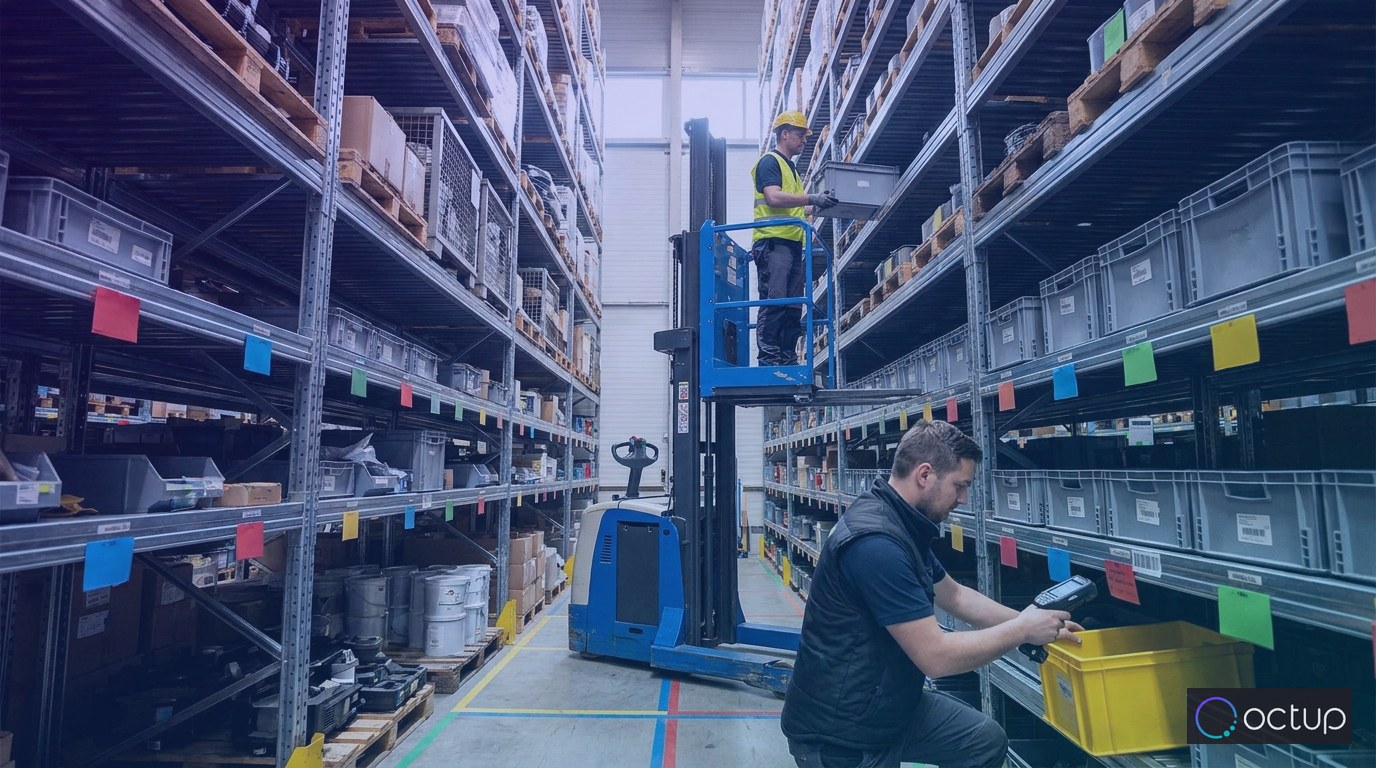
1. Segregate inventory physically and logically. 3PL warehouse slotting applies to multiple simultaneous client inventories that must be physically and logically segregated. Operators assign dedicated zones to high-volume accounts and use shared racking for smaller accounts, where the WMS assigns location-level ownership to a single client so stock never commingles.
2. Slot by per-client velocity, never warehouse-wide velocity. Each client's SKU set receives its own ABC velocity analysis. A SKU that is high-velocity for Client A can sit dormant for Client B, and mixing velocity logic across clients produces pick path collisions and mis-picks rather than efficiency gains. The storage flow and slotting fundamentals covers per-client zone construction.
3. Count continuously with tiered cycle counts. Cycle counting is a continuous inventory accuracy method that replaces or supplements annual physical inventory counts. Frequency tiers follow client value and SKU turnover, so fast-moving high-value SKUs are counted weekly while slow movers rotate quarterly. The scheduling counts in shared warehouses details tier design for mixed-client buildings.
4. Measure location accuracy against client benchmarks. Location accuracy (locations with correct quantities ÷ total locations counted × 100) differs from unit count accuracy, and brand clients audit the location figure. Industry-standard KPIs place the benchmark at 99.5% or higher (Cubework, 2026), best-in-class warehouses maintain 99.5% or higher (Infios, 2026), and RFID-equipped 3PL operations average 99.2% (Gitnux, 2026). The auditing inbound and outbound flow performance covers how these figures feed client scorecards.
When a brand requests kitting, bundling, or labeling at receiving rather than at outbound, the warehouse opens a separate receiving work order. The units wait in a staging zone until the VAS task completes and the stock is re-received into sellable inventory.
What does the outbound flow look like in a 3PL warehouse, from order release to carrier handoff?
The outbound flow moves a released order through pick method selection, scan-validated picking, standardized packing, label generation with manifest close, and a final quality control check before the carrier takes custody. Outbound quality control precedes carrier handoff and is the last internal checkpoint before a mis-ship reaches the end customer.

Order release enters the WMS, which assigns each order a pick method. Pick method selection is caused by order profile characteristics: volume, SKU density, and order line count. High-volume single-line orders suit batch picking, low-volume multi-line orders suit discrete picking, and the discrete and batch picking methods resource compares wave and zone options against both. Pickers confirm each unit through UPC scan validation, and a mis-pick rate above 0.5% signals a picking-process or labeling issue, according to Cubework in 2026.
At the pack station, cartonization logic selects the smallest suitable carton, dunnage protects the contents, and client-specific pack slips and inserts go in before sealing. The costliest outbound failure is mis-packing, not mispicking: an oversized carton triggers a carrier dimensional weight surcharge the 3PL typically absorbs when the client contract does not pass the charge through. Carriers calculate DIM weight as length × width × height ÷ DIM factor, and packages billed at dimensional weight cost 37% more for ground and 45% more for next-day air, according to MHL News in 2015. Shipware reported in 2026 that a $3 DIM overcharge across 10,000 monthly shipments equals $360,000 per year.
Quality control verifies contents, weight, label, and seal before staging. The WMS then generates labels through rate shopping or a client-designated carrier and closes the manifest, and the post-pick carrier handoff process documents that final custody transfer. B2B and wholesale orders follow a different workflow with palletized freight, retailer compliance labels, and EDI-triggered ASNs, requiring separate SOPs and WMS configuration. The streamlining inbound and outbound warehouse flows resource shows how these handoffs align with receiving.
How should a 3PL handle returns, and why do most operators get it wrong?
A 3PL handles returns through RMA matching at intake, unit-level inspection, condition grading, and a restock-or-quarantine decision written to the client's inventory record. Most operators fail by marking a return processed before the client's stock updates and the consumer's refund unblocks.
Return volumes demand a disciplined workflow. SEKO Logistics (2026) puts U.S. merchandise returns at $890 billion in 2024, roughly 16.9% of total retail sales, and Selery Fulfillment (2026) reports 19.3% of online orders returned versus 8.7% in-store, with apparel above 40%.
Returns processing contains inspection, condition grading, a restocking or quarantine decision, and client-facing discrepancy reporting. The intake workflow runs four steps.
1. RMA matching. Receiving matches each unit to its return merchandise authorization; returns without one enter exception handling pending client disposition. 2. Unit-level inspection. Staff verify item identity, quantity, and signs of use or tampering. 3. Condition grading. The inspector grades each unit resalable, unsalable, or vendor-return. 4. Restock or quarantine. Resalable units return to available stock; unsalable units enter quarantine, and the WMS writes the outcome to the client's inventory record.
A dual accountability gap separates "the 3PL processed the return" from "client inventory is updated and the refund is unblocked." The 3PL owes the brand inventory accuracy on restocked returns; the brand owes the end consumer refund timing. These timelines rarely align. Operators that conflate processed with restocked generate most client escalations from this single misunderstanding, and the operational errors that lose 3PL clients rank the conflation among the most damaging.
Brand clients require return reason codes, condition grades, restock timestamps, refund status, and quarantine aging on a daily or weekly cadence, yet most 3PLs under-report with received counts only. Liability exposure is growing: according to WarehousingAndFulfillment.com (2025), 94.33% of warehouses now cover shipping, picking, and inventory errors when at fault, up from 85% in 2024.
A 3PL operator serves clients through inbound, storage, outbound, and returns flows, the four operational accountability pillars of client SLA performance. The outbound-to-return cycle management details the full loop from shipment to restock.
Sources
- WarehousingAndFulfillment.com, "2025 Warehousing Cost and Fulfillment Survey" (2025)
- Cubework, "3PL Warehousing KPIs That Actually Matter" (2026)
- Gitnux, "3PL Fulfillment Industry Statistics | 2026 Edition" (2026)
- Shipware, "Dimensional Weight Shipping: How Carriers Bill for DIM" (2026)
- SEKO Logistics, "Overcoming Challenges With 3PL Returns Management" (2026)
- Selery Fulfillment, "Ecommerce Returns Management: How a 3PL Handles Reverse Logistics (2026 Guide)" (2026)

Octup



About the Author: Alon Partuk
Alon Partuk is Founder & CEO at Octup. Alon built Octup after seven years in D2C, scaling his brand Apricoat into a multi-million dollar company — where he lived the 3PL pain firsthand: missing visibility into inventory, marketing performance, and SKU-level costs. He launched Octup in 2022 as the first platform to unite warehouse intelligence with billing automation, purpose-built to close the gaps WMS platforms leave behind. Connect with Alon on LinkedIn.
Related Posts

.webp)