3PL Technology and AI Adoption Trends

Technology adoption now separates the top quartile of 3PL fulfillment operators from the mid-market majority. 3PL operators running modern SaaS warehouse platforms and AI-assisted workflows outperform peers on order accuracy, client retention, and labor productivity. Yet adoption across the 3PL industry remains uneven: legacy WMS installations and spreadsheet-based workflows still run much of mid-market order fulfillment. SaaS migration and production AI deployments are widening that performance gap through 2026.
What is the current state of technology adoption across the 3PL industry?
Third-party logistics operators adopt technology unevenly in 2026: warehouse management systems anchor most operator stacks, while billing, client portals, and carrier management lag behind. Adoption concentrates among high-volume 3PLs, and smaller operators still run core workflows on spreadsheets and legacy on-premise systems.

The adoption picture breaks into four categories:
- Warehouse management systems: WarehouseWiz (2024) reports an 87% WMS adoption rate among surveyed 3PLs, making WMS the most widely implemented technology in the sector; SellersCommerce (2026) projects that over 90% of warehouses will use or plan WMS adoption by 2027.
- Order management systems: SellersCommerce (2026) records a 52% implementation rate among 3PLs, well below WMS penetration.
- Billing software and client portals: adoption lags WMS significantly across operator segments.
- Spreadsheet dependence: a substantial share of 3PLs, concentrated among SMB operators, still executes core workflows on spreadsheets or legacy on-premise systems in 2026.
Penetration splits sharply by operator volume. WMS adoption runs high among 3PLs processing over 500 orders per day, where throughput justifies license and implementation costs, and drops markedly among operators under that threshold. Below that line, receiving, picking, and inventory control still run on manual files. Anyone who has worked a peak season on paper knows where those hours go.
One caveat governs every headline figure: WMS penetration statistics overstate actual tech maturity. A 3PL can operate a capable WMS and still run billing, client reporting, and carrier rate management on spreadsheets. The relevant measure of maturity is integrated platform coverage across the full operational stack, not WMS presence alone. Owning a WMS answers the storage-and-labor question; connecting the WMS to billing, client portals, and carrier management answers the cash-and-visibility question.
Many 3PLs with modern WMS implementations still invoice on spreadsheets and provide no self-service visibility to clients. The result is a two-speed tech stack: the warehouse floor runs on software while the back office runs on manual process, which slows cash collection and inflates support volume.
Operator size predicts stack maturity. Enterprise 3PLs run integrated stacks across warehousing, billing, and carrier management; SMB operators typically stop at a standalone WMS or a patchwork of disconnected tools. The gap compounds. The 2025 NTT DATA survey reports that 62% of shippers cite technology as an area in need of change and 63% of surveyed 3PLs list technology as a key driver of change, so shipper pressure now pushes laggard operators toward integration.
The annual tech adoption benchmark report tracks platform penetration by operator segment across WMS, order management, billing, and client portals. State of 3PL Technology Adoption: 2026 Survey Results compiles the primary data behind these segment breakdowns. The five supply chain innovations for eCommerce profiles the adjacent tool categories that growth-stage operators add once the core stack stabilizes.
How Is AI Being Deployed in 3PL Operations Today, and What Is Actually in Production?
AI deployment in 3PL is predominantly pilot-stage in 2026, with production-grade AI concentrated in demand forecasting and billing anomaly detection. Carrier rate optimization also runs in production at large multi-facility 3PLs, while fully autonomous receiving and generative AI client reporting remain experimental.

Surveys of 3PL AI adoption trends and tools show three use cases crossing from pilot to production. According to Logistics Management's 29th Annual 3PL Study (2024), 33% of shippers seek AI implementations in supply planning and demand forecasting, while 19% of 3PLs plan implementations in the same area. Billing anomaly detection ships inside modern billing modules and flags accessorial and rate-card errors before invoicing. The same study reports 27% of shippers demand AI-driven transportation and route optimization, and 22% of 3PLs plan to deploy route optimization. AI adoption in 3PL warehouse settings concentrates in these data-rich workflows, and How AI Is Changing 3PL Warehouse Operations: Real-World Applications maps each deployment to the workflow it automates.
Two use cases stay experimental. Fully autonomous receiving still needs exception handling that most facilities cannot staff. Generative AI for client-facing work, including automated shipment exception summaries and natural-language reporting, is emerging in 2026 as an early differentiator among enterprise 3PLs and has not reached mid-market operators.
The adoption gap between segments tracks data infrastructure, not interest. AI adoption trends in fulfillment follow a fixed sequence:
1. An operator migrates to a modern SaaS WMS. 2. The platform produces clean, structured operational data. 3. Production AI deploys against that data. 4. Experimental AI pilots follow.
Large multi-facility 3PLs finished steps one and two on enterprise platforms and operate production AI in 2026; mid-market operators on legacy systems sit gated at step one. The 2024 study quantifies the gate: 28% of 3PLs cite integration with existing systems as the main barrier, 25% cite lack of skilled personnel, and 14% cite high initial investment, burdens that hit mid-market budgets hardest. Interest is not the bottleneck. AI drew 94% of replies in the 2025 Inbound Logistics 3PL Market Research Report as the most impactful technology, up 10 percentage points in two years. The AI adoption trajectory in 3PL runs through SaaS migration first.
Why are 3PLs migrating from on-premise and legacy software to SaaS platforms?
3PLs migrate to SaaS platforms because SaaS lowers upfront capital costs, shortens implementation timelines, and delivers continuous updates without IT overhead. SaaS platform migration also precedes AI and automation adoption, because legacy on-premise and spreadsheet infrastructure cannot feed clean, structured data to AI models.

The economics favor cloud deployment first. MarketsandMarkets (2025) reports that cloud-based WMS solutions lead the market due to lower cost, scalability, flexibility, and ease of integration compared with on-premises systems, and Straits Research values the global WMS market at $4.21 billion in 2024, growing at a 15.3% CAGR toward $15.16 billion by 2033. An operator onboarding a client in August cannot wait out a server procurement cycle before peak season. SaaS vs. On-Premise Software in 3PL Operations: Why Cloud Won documents the full cost and control comparison behind that shift.
AI raises the stakes. AI and automation tools require structured, real-time data that legacy on-premise stacks cannot supply consistently. MarketsandMarkets (2025) notes that large enterprises and global 3PL providers demand WMS platforms with AI, IoT integration, real-time analytics, and multi-site management, capabilities concentrated in the emerging 3PL software categories built cloud-native. Operators who bolt those tools onto legacy infrastructure watch them underperform on dirty data.
The holdouts cluster in two groups: operators in highly regulated verticals such as pharma and cold chain, and warehouses with heavy ERP integration dependencies. MarketsandMarkets (2025) found that the on-premises WMS segment retained a significant share in 2024 among large enterprises in automotive, healthcare, and 3PL that prioritize control, data security, and customization. Multi-client operations add a further complication: client data isolation, custom billing rule sets, and per-client portal configuration were once handled through on-premise customization, so SaaS platforms must replicate each capability natively. The operational record behind why 3PLs moved away from on-premise infrastructure shows those objections shrinking as multi-tenant platforms mature.
Where does warehouse robotics fit into 3PL technology adoption — and who can actually afford it?
Warehouse robotics sits at the top of 3PL technology adoption. Autonomous mobile robots concentrate in large, high-volume facilities where 1,000 or more daily orders justify the capital. Mid-market 3PLs will mostly reach robotics through robotics-as-a-service subscriptions rather than ownership.
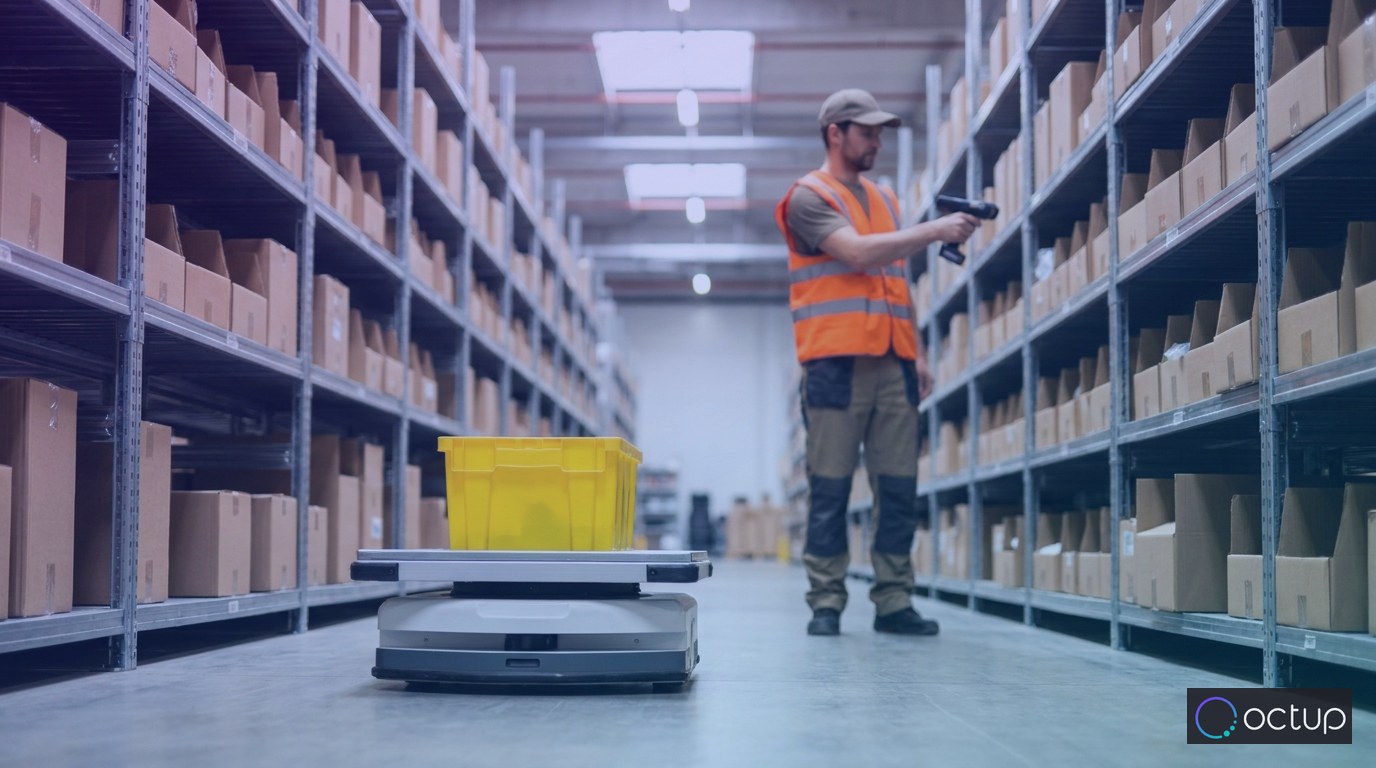
Actual penetration stays thin outside the largest networks. Deployments cluster in big, high-volume sites with national retail clients, where robots cut walk time across tens of thousands of daily picks. The tech spending gap in small warehouses quantifies how far mid-market operators trail large networks, and ABI Research's 2025 data points the same way: only 37% of 3PL providers plan to invest more than $100,000 in machine vision solutions over the next two years, against 55% of manufacturers and 49% of retailers.
Warehouse robotics applies to 3PL operators above a clear volume and capital threshold: roughly 1,000 daily orders per facility, usually across multi-facility footprints. Ownership math holds only when volume survives client renewals, and payback on purchased AMR fleets runs in years, so an operator buying robots against a three-year client contract carries real churn risk. Below that line, ownership stays inaccessible to the mid-market majority.
Robotics-as-a-service changes the entry point. RaaS converts a capital purchase into a monthly operating cost, and some providers now serve 3PLs shipping 300 to 500 daily orders. The bottleneck moves to the operator: floor layout and WMS integration capability block deployments that capital alone would clear. For teams benchmarking where warehouse robotics adoption stands today, the dividing line sits at integration readiness as much as order count.
What separates tech-forward 3PL operators from laggards, and is the gap closing?
Tech-forward 3PL operators separate from laggards through higher order accuracy, stronger SLA attainment, and better client retention, and the gap is widening rather than closing because data flywheel effects compound early technology investments into durable operational advantages.

The operational advantages of technology-led 3PLs surface first in the numbers brand clients audit: order accuracy, SLA attainment, and renewal rates. An operator running a modern WMS with disciplined scanning mis-ships fewer orders and misses fewer cutoff times, and those two metrics decide renewals more often than rate cards do.
Brand clients now use technology capability as a selection criterion when awarding contracts to tech-forward 3PL operators. Client RFPs increasingly include technology capability assessments and portal/API requirements, and real-time visibility has become a baseline expectation. According to a 2024 WarehouseWiz survey, 93% of 3PL users believe strong IT capabilities are an important component of a 3PL partner, yet only 55% say they are satisfied with their 3PL's IT abilities. Logistics Management reported in 2024 that 13% of shippers would be very likely and 32% somewhat likely to switch 3PL providers based on AI capabilities, and the what's next for 3PLs and e-commerce in 2025 outlook covers how AI scoring is entering standard shipper RFP criteria.
The gap widens because tech-forward operators run a compounding loop: better data produces better AI outputs, better AI outputs improve operations, better operations retain clients, and retained clients fund the next technology round. Laggards run the inverse cycle. Open Sky Group reports in 2026 that companies with AI-mature supply chains are 23% more profitable than their peers, while only 23% of supply chain organizations have a formal AI strategy in place.
ROI uncertainty, capital constraints, and change management friction, not lack of awareness, cause the technology investment gap among small and mid-market 3PL operators. Most laggard operators know exactly which tools the warehouse lacks; the blocker is proving payback to ownership while the floor runs on thin peak-season margins.
Sources
- WarehouseWiz, "34+ 3PL Industry Statistics to Know in 2025" (2024)
- SellersCommerce, "Warehouse Automation Statistics (2026)" (2026)
- NTT DATA, "NTT DATA 2025 Third-Party Logistics Study" (2025)
- Straits Research, "Warehouse Management System Market Size, Share, Growth, Analysis, 2034"
- MarketsandMarkets, "Warehouse Management System Market Size, Share, Latest Trends & Growth Analysis, 2025 - 2030" (2025)
- Logistics Management, "29th Annual 3PL Study examines impacts of change management, AI, and fast shipping" (2024)
- ABI Research, "2025 Supply Chain Survey Results - Artificial Intelligence (AI) Usage and Investment Plans" (2025)
- Open Sky Group, "Supply Chain AI Statistics: 18+ Statistics You Should Know for 2026" (2026)

Octup



About the Author: Alon Partuk
Alon Partuk is Founder & CEO at Octup. Alon built Octup after seven years in D2C, scaling his brand Apricoat into a multi-million dollar company — where he lived the 3PL pain firsthand: missing visibility into inventory, marketing performance, and SKU-level costs. He launched Octup in 2022 as the first platform to unite warehouse intelligence with billing automation, purpose-built to close the gaps WMS platforms leave behind. Connect with Alon on LinkedIn.
Related Posts