The Complete Guide to E-Commerce Order Fulfillment
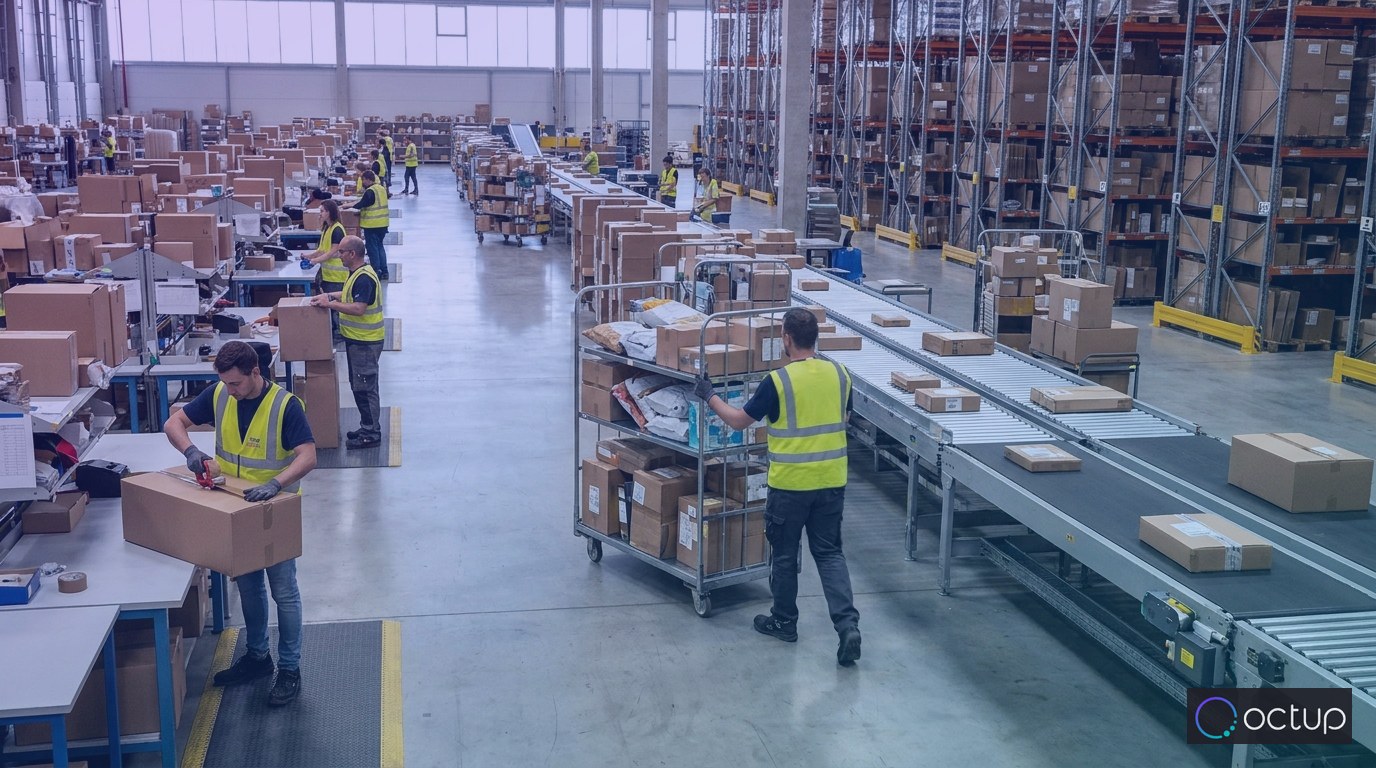
E-commerce order fulfillment is the end-to-end process by which online retailers and their 3PL partners receive, process, pick, pack, ship, and handle returns for customer orders. Order fulfillment determines whether a brand's post-purchase experience builds loyalty or destroys it. Every fulfillment decision, from warehouse location to 3PL selection to returns policy, compounds into the unit economics that decide whether a brand scales profitably or stalls. Brands and 3PL operators measure e-commerce order fulfillment with cost-per-order, accuracy, and SLA metrics.
What Is E-Commerce Order Fulfillment and What Does the End-to-End Process Include?
E-commerce order fulfillment is the complete operational process that moves a customer order from purchase confirmation to final delivery, and the process includes returns processing. Fulfillment covers every step between order placement and the customer's doorstep, not only picking and packing.
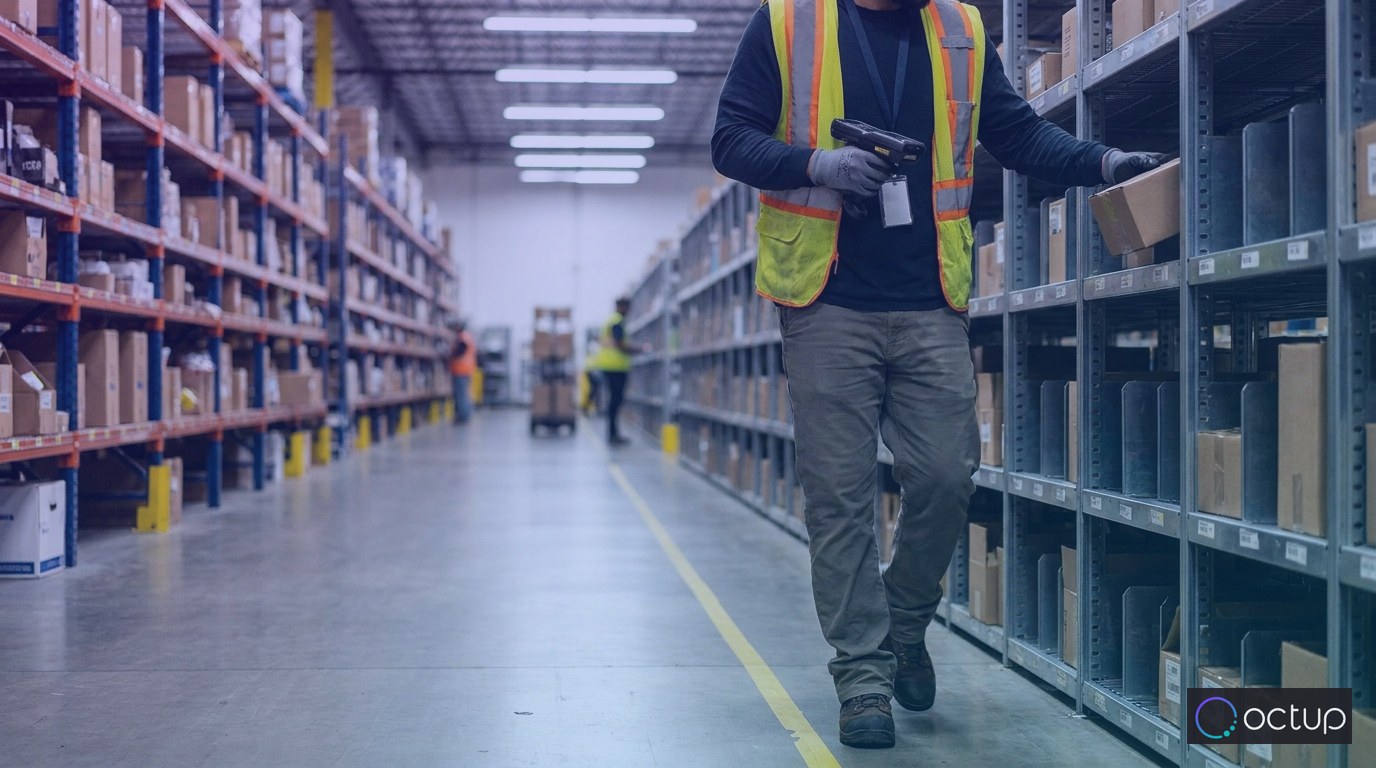
E-commerce order fulfillment contains six sequential stages: receiving, storage, order processing, pick and pack, shipping, and returns.
1. Receiving inventory. Warehouse staff count, inspect, and log inbound stock into the warehouse management system. 2. Storage. The fulfillment center holds inventory in assigned bin, shelf, or pallet locations until an order triggers retrieval. 3. Order processing and routing. The order management layer validates each order, confirms available stock, and routes the order to the best fulfillment location. 4. Pick and pack. Warehouse staff retrieve the ordered items and pack the items with correct materials and shipping documents. 5. Carrier handoff and shipping. The fulfillment center tenders labeled parcels to a carrier, and the carrier transports the parcels to the customer's address. 6. Returns processing. The reverse logistics flow receives returned items, inspects condition, and restocks, refurbishes, or scraps each unit.
Fulfillment is the physical execution layer. Order management is the data and system layer. An order management system records order status, inventory levels, and routing decisions as data; fulfillment performs the labor and freight movement that turns those records into delivered parcels. Operators frequently conflate the two terms, yet a brand can run advanced order management software while a 3PL performs every fulfillment task.
Every stage carries its own cost drivers, failure modes, and performance metrics. Receiving costs scale with labor per pallet, storage costs scale with cubic footage per month, and shipping costs scale with carrier zone and parcel weight. Mis-scans at receiving, stockouts in storage, and missed carrier pickups each break a different link. The end-to-end online order fulfillment explained details the metrics 3PL operators track at each stage.
What Are the Different E-Commerce Fulfillment Models Brands Can Choose From?
Brands choose from four e-commerce fulfillment models: in-house fulfillment, third-party logistics (3PL), dropshipping, and marketplace fulfillment such as Fulfillment by Amazon (FBA). Each model assigns inventory ownership, warehouse labor, and shipping responsibility to a different party with distinct cost and control tradeoffs.

- In-house fulfillment (self-fulfillment): The brand stores inventory in a brand-operated facility, and the brand's staff picks, packs, and ships each order. The model gives the brand full packaging and unboxing control but demands warehouse space, labor, and carrier contracts as volume grows.
- Third-party logistics (3PL): A 3PL provider stores the brand's inventory in the provider's warehouses and picks, packs, and ships orders to the brand's specifications. The brand keeps control of packaging, carriers, and channel strategy in exchange for managing the provider relationship through service-level agreements.
- Dropshipping: The supplier ships products directly to the customer, and the brand never holds inventory. Dropshipping minimizes upfront inventory cost while limiting the brand's control over stock availability, packaging, and delivery speed.
- Marketplace fulfillment (FBA): Amazon stores the brand's inventory in Amazon fulfillment centers and ships orders placed on the Amazon marketplace. FBA orders qualify for Prime delivery speeds.
The 3PL model and FBA sit at opposite ends of the control spectrum: a 3PL executes to the brand's specifications across any sales channel, while FBA limits the brand to Amazon's packaging rules and Amazon's marketplace in exchange for Prime speed. Mid-market brands often run hybrid models where a 3PL handles direct-to-consumer orders and FBA handles Amazon orders. Hybrid fulfillment introduces inventory coordination complexity, because the brand must allocate stock between the 3PL warehouse and Amazon fulfillment centers, rebalance units between channels when one channel outsells the forecast, and recover split-inventory visibility when the two networks report stock levels in separate systems.
Brands select a model by weighing order volume, SKU complexity, geographic reach, and brand experience requirements. The 3PL vs in-house fulfillment comparison details the cost and scalability tradeoffs between those two models.
How does the 3PL fulfillment process work for e-commerce brands?
The 3PL fulfillment process runs in two flows. Inbound, the brand ships inventory to the 3PL warehouse, where receiving and putaway make the stock available for orders. Outbound, a store checkout triggers the 3PL's warehouse management system to pick, pack, label, and ship the order, and tracking data syncs back to the brand's storefront.

1. Inbound freight: The brand ships inventory to the 3PL warehouse, usually against an advance shipping notice that tells the warehouse what to expect. 2. Receiving and putaway: The 3PL counts, inspects, and stows the inventory. The stock then becomes available for order allocation. 3. Order trigger: A customer checkout on the brand's store sends the order to the 3PL's warehouse management system. 4. Pick, pack, label: Warehouse staff picks the ordered items, packs the parcel, and applies the carrier label. 5. Carrier handoff: The carrier collects the parcel, and the tracking number syncs back to the brand's storefront so the customer can follow the shipment.
The integration layer connects the 3PL to the brand's e-commerce platform, such as Shopify, to carrier accounts, and to inventory systems. Operational failures often originate here. A broken storefront connection delays order release, and a stale inventory feed causes overselling.
A 3PL operator runs this workflow simultaneously across multiple brand clients, so standardization and visibility tooling determine operations quality. Standardized receiving, picking, and exception-handling procedures keep service levels consistent from one client to the next, while visibility dashboards let each brand monitor its own orders and stock. The 3PL platform for e-commerce fulfillment covers the software category that centralizes this multi-client orchestration.
What does e-commerce order fulfillment actually cost, and how is cost-per-order calculated?
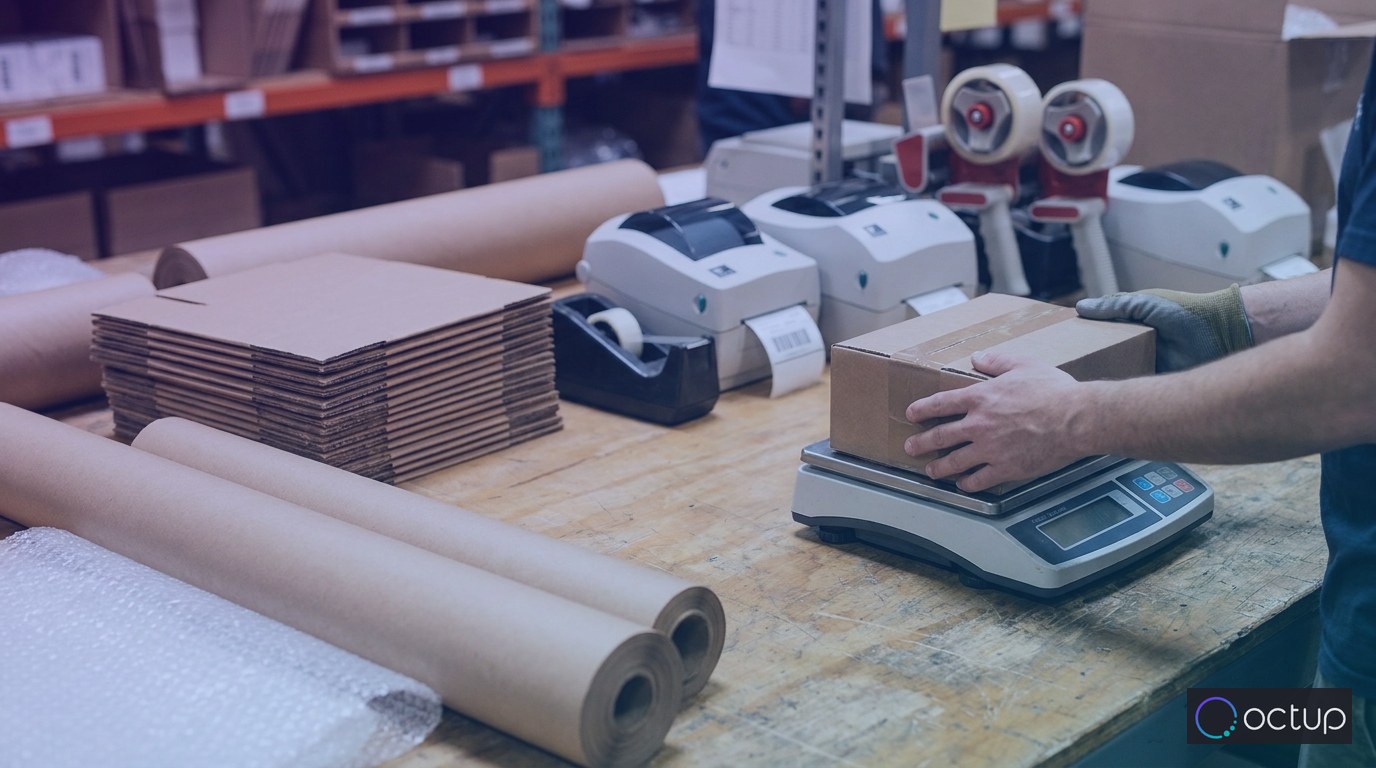
Fulfillment cost is a composite of six components: inbound receiving fees, storage fees, pick-and-pack fees, packaging materials, outbound shipping, and return processing fees. Cost-per-order (CPO) divides total monthly fulfillment spend by orders shipped, counting all six components.
| Cost component | Typical billing basis | What drives the cost |
|---|---|---|
| Inbound receiving | Per pallet, carton, or unit | Shipment size, SKU count |
| Storage | Per pallet or cubic foot, monthly | Inventory volume, storage turns |
| Pick and pack | Per order plus per item | Items per order |
| Packaging materials | Per order | Box size, dunnage |
| Outbound shipping | Per parcel, by weight and zone | Carrier choice, customer distance |
| Return processing | Per returned order | Return rate, inspection steps |
Last-mile delivery carries the largest share of total fulfillment cost, which makes carrier selection and zone optimization the highest-leverage cost lever in the structure. Cutting per-parcel spend, or shipping from zones closer to customers, moves CPO further than renegotiating pick fees.
Brands consistently undercount CPO because they treat pick, pack, and shipping as the whole fulfillment cost and exclude storage carrying cost, inbound freight, and returns. Storage never appears in a per-order tally because 3PLs bill storage monthly per pallet or cubic foot, and storage turns determine how large that exclusion is: slow-moving inventory sits for months, accumulating charges that fast-turning SKUs never incur. A brand shipping 1,000 orders a month with $9,000 in pick, pack, packaging, and postage calculates CPO as $9.00; adding $1,800 in storage, $900 in receiving, and $600 in returns raises fully loaded spend to $12,300 and the true CPO to $12.30.
CPO is not fixed. Per-pick fees, monthly minimums, and accessorial charges shift the figure with order profile, SKU mix, and volume tier, so two brands on the same rate card pay different effective CPOs. The 3PL billing strategy and revenue management behind a rate card determine how those variables scale, and brands should model CPO at their own volume before comparing providers.
When Should an E-Commerce Brand Outsource Fulfillment to a 3PL?
An e-commerce brand should outsource fulfillment to a 3PL when order volume exceeds in-house capacity, when customers cluster in distant shipping zones, when warehouse capital is unavailable, or when leadership must redirect operating attention toward product development and marketing.

Third-party logistics fulfillment serves e-commerce brands that have outgrown in-house fulfillment or that need geographic distribution without capital investment. Four triggers signal readiness:
- Capacity strain: a self-fulfilling brand misses shipping cutoffs, error rates climb, and staff hours shift from growth work to packing boxes.
- Geographic demand: a brand shipping nationwide from one warehouse pays cross-country zone rates and accepts slow transit times, while a 3PL distributes inventory across regional facilities closer to customers.
- Capital constraints: leases, racking, equipment, and warehouse labor require upfront investment, and a 3PL converts those fixed costs into variable per-order fees.
- Strategic focus: fulfillment management competes directly with product and marketing for leadership attention, so outsourcing returns that attention to the core business.
Outsourcing does not automatically cut costs. 3PL pricing combines per-pick fees, monthly account minimums, and accessorial charges, so brands at low order volumes frequently spend more per order with a 3PL than with self-fulfillment. Savings emerge at scale, where zone skipping and shared labor efficiency outweigh the fee structure. The correct decision trigger is the break-even threshold between the two models, not headcount or warehouse space alone.
A 3PL shortens speed-to-market, absorbs peak-season surges with elastic labor, manages multi-channel complexity such as marketplace routing and retail compliance, and protects brand experience consistency across every shipment.
The outsourcing fulfillment or keeping it in-house decision framework covers the full evaluation methodology, including total-cost modeling and service-level scoring.
How does inventory management affect fulfillment accuracy and brand performance?
Inventory management determines fulfillment accuracy because a 3PL can only ship stock its warehouse management system confirms as available and physically locatable. Accurate records produce complete, on-time orders. Inaccurate records produce cancellations, oversells, and lasting damage to brand reputation.
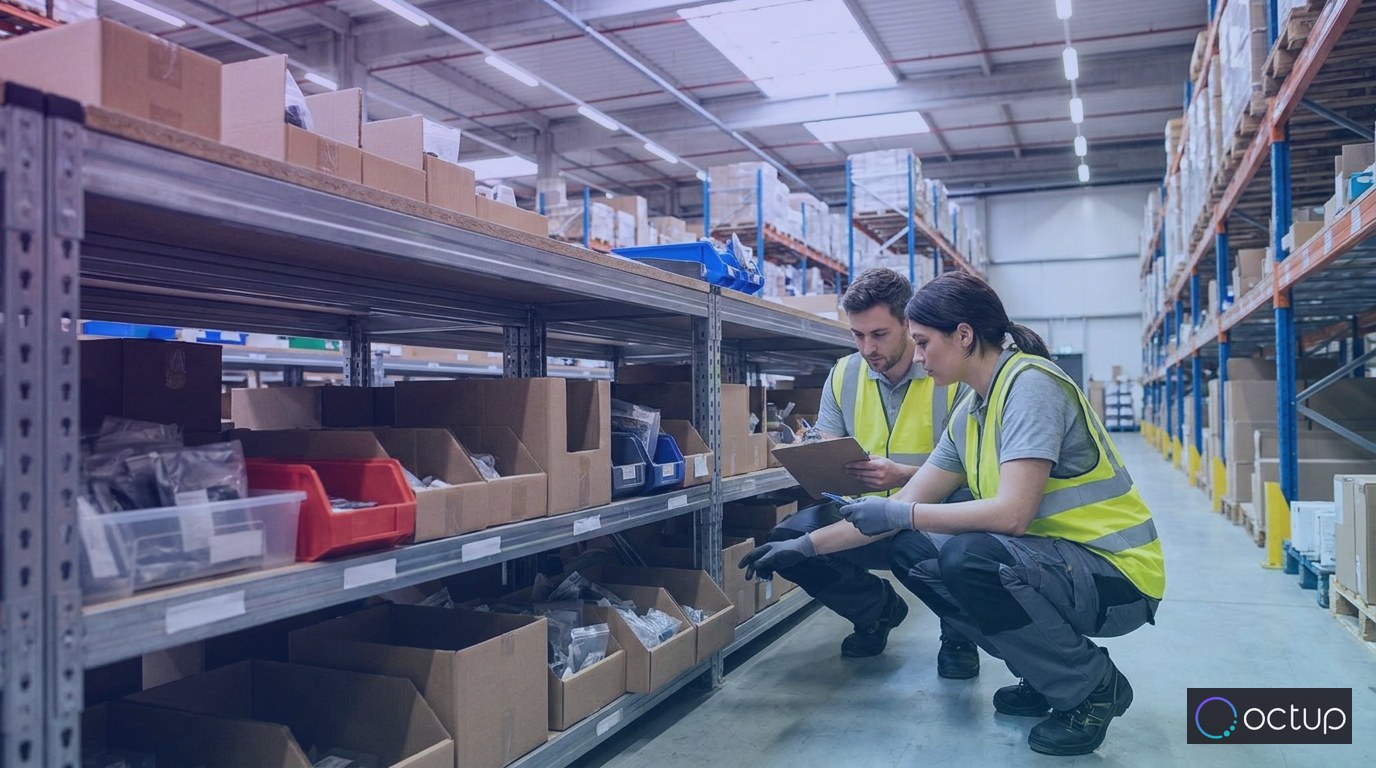
Inventory accuracy is the upstream determinant of every downstream fulfillment metric. Physical stock must match system records before any order can allocate, and a 3PL cannot ship a unit it cannot locate. Most picking errors and backorders that surface at the shipping stage trace back to discrepancies created earlier in the inventory lifecycle.
Responsibility splits between both parties. Inventory accuracy applies to both the brand and the 3PL as a shared-responsibility metric with contractual SLA implications. Brands control inbound demand forecasting and replenishment decisions; 3PLs control putaway accuracy, cycle counting cadence, and the system updates that keep records synchronized.
The accuracy chain runs through five handoffs:
1. The brand forecasts demand and issues replenishment purchase orders to its suppliers. 2. The 3PL receives inbound shipments and verifies physical counts against advance shipping notices. 3. The 3PL puts stock away and records exact bin locations in the WMS. 4. The 3PL runs scheduled cycle counts to reconcile physical stock against system records. 5. Order allocation and picking draw on those records, so any error introduced earlier surfaces here as a mispick, stockout, or oversell.
Three failure modes degrade brand performance when this chain breaks. Stockouts result from poor demand forecasting and leave orders unfillable. Overstock results from over-replenishment, inflating storage fees and tying up working capital. Phantom inventory results from WMS synchronization errors that show units which do not physically exist, so customers buy products the warehouse cannot ship.
The 3PL fulfillment inventory basics covers forecasting methods, replenishment workflows, and real-time visibility tools for operators building these controls.
How do e-commerce returns work, and what operational burden do they place on 3PLs?
E-commerce returns move through reverse logistics: the 3PL receives the returned parcel, inspects each unit's condition, sorts units to restock, refurbish, liquidate, or dispose, updates the inventory system, notifies the brand, and charges a per-return processing fee for the work.
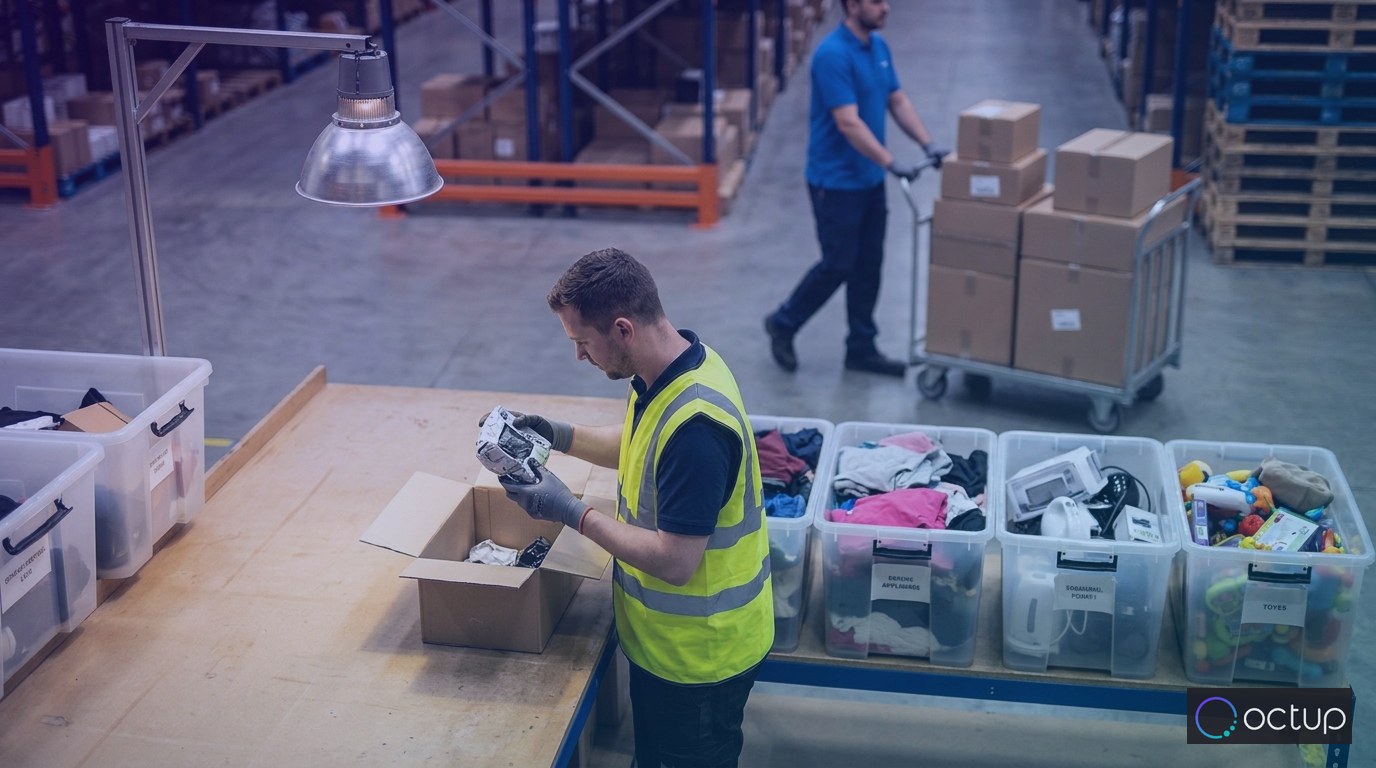
Return volume drives the burden. Each returned parcel must be received, inspected, graded, routed to one of the four disposition streams, and written back into the inventory system before the brand is notified. This volume makes reverse logistics a core operational function for 3PL operators, requiring dedicated labor, floor space, and warehouse management system capacity every operating day.
The returns processing workflow at a 3PL follows five steps:
1. Receive. The intake team receives the returned parcel, scans the return authorization or tracking number, and matches the parcel to its original order. 2. Inspect. A trained associate inspects each unit for damage, wear, and completeness, then assigns a condition grade. 3. Sort. The condition grade routes each unit into one of four disposition streams: restock, refurbish, liquidate, or dispose. 4. Update inventory. The warehouse management system returns graded units to sellable stock in real time when the disposition is restock. 5. Notify the brand. The system triggers a brand notification carrying disposition details, condition notes, and refund eligibility data.
3PLs price this work as a per-return processing fee, frequently combined with a restocking fee when units re-enter sellable inventory. Brands should factor both fees into customer-facing return policy design: a free-returns policy pushes the full processing cost into the brand's margin, while a customer-paid restocking fee recovers the cost but can depress conversion and repeat purchase rates. The returns management sub-pillar, building a reverse logistics strategy, covers complete policy design, disposition planning, and cost modeling for this tradeoff.
What fulfillment KPIs and SLAs should brands and 3PLs track?
Brands and 3PLs should track six core fulfillment KPIs: order accuracy rate, on-time ship rate, order cycle time, inventory accuracy, cost-per-order, and return processing time. Together, these metrics define the baseline a fulfillment SLA enforces.
- Order accuracy rate: orders shipped without errors.
- On-time ship rate: orders dispatched within the promised window.
- Order cycle time: elapsed time from order receipt to carrier handoff.
- Inventory accuracy: match between system counts and physical stock.
- Cost-per-order: fulfillment spend divided by order volume.
- Return processing time: days from return receipt to restock.
Order accuracy rate and on-time ship rate are lagging indicators: both confirm failure only after customers receive wrong or late orders, so a 3PL tracking only lagging metrics finds breaches after churn and brand damage have occurred. Operationally sophisticated 3PLs add leading indicators, chiefly pick error rate per shift and carrier scan rate at manifest, which surface SLA risk before it reaches brand-reported complaints. A rising pick error rate on one shift predicts an accuracy miss days later; a low manifest scan rate flags late shipments hours before the ship cutoff passes.
A fulfillment SLA arises from contractual commitments between 3PL operators and brand clients on order accuracy, ship time, and damage rates. Four components give an SLA teeth. Thresholds set numeric floors, such as 99.5% order accuracy or same-day shipping for 98% of orders received before a 2 p.m. cutoff. Measurement windows fix the evaluation period, usually one calendar month. Penalty triggers fire when a metric misses its floor inside a window: the 3PL issues a service credit equal to a percentage of that month's fulfillment fees or a fixed amount per late order. Escalation procedures govern repeat misses: two consecutive failed windows trigger a root-cause review and remediation plan, and a third grants the brand renegotiation or termination rights.
Brands cannot enforce SLAs they cannot measure. Verification requires timestamped records of every pick, pack, and ship event, not a 3PL's self-reported summary. The e-commerce fulfillment management platform captures those events in real time and shares the records with brand clients, making shared data visibility a prerequisite for any enforceable SLA framework.
How do 3PL operators manage fulfillment operations across multiple brand clients?
3PL operators manage multi-client fulfillment by configuring each brand's SKU profiles, service-level agreements, packaging rules, and carrier preferences as distinct workflows, supervising all accounts from one operational view, and billing every client at the activity level.
The operating model runs in four steps:
1. Configure each client as a distinct operating profile. A 3PL runs simultaneous fulfillment workflows for many brands, and each brand brings different SKU profiles, SLAs, packaging requirements, and carrier preferences. Per-client rules replace one-size-fits-all execution. 2. Supervise the full client base from a unified operational view. Managers need cross-client visibility to catch exceptions, balance labor across accounts, and report performance. Spreadsheets and point tools fail at this scale because each disconnected tool fragments the picture. 3. Capture every billable activity against the correct client. Each pick, storage day, and accessorial service maps to a client and a contracted rate, creating the audit trail that proves what work the 3PL performed. 4. Report activity and cost back to each brand. Brand-facing reporting converts raw activity data into reconcilable invoices and performance summaries.
Most 3PL-brand relationships fail over billing opacity rather than fulfillment errors. Brands cannot reconcile 3PL invoices when activity-level billing data is missing, and 3PLs cannot prove the value of accessorial services without audit trails. Transparent, activity-level billing data works as a retention tool for 3PLs and a trust signal for brands evaluating 3PL partners.
3PL fulfillment operators use Octup to unify billing automation, analytics, and client-facing reporting in a single platform. Octup's billing automation applies each client's contracted rates to captured activity and generates invoices without manual reconciliation. The analytics layer consolidates exception queues, SLA attainment, and labor utilization across every account, while brand-facing reporting gives each brand direct visibility into its own orders and charges. The 3PL operator's comprehensive handbook covers how these platform capabilities fit the full multi-client operating model.

Octup



About the Author: Alon Partuk
Alon Partuk is Founder & CEO at Octup. Alon built Octup after seven years in D2C, scaling his brand Apricoat into a multi-million dollar company — where he lived the 3PL pain firsthand: missing visibility into inventory, marketing performance, and SKU-level costs. He launched Octup in 2022 as the first platform to unite warehouse intelligence with billing automation, purpose-built to close the gaps WMS platforms leave behind. Connect with Alon on LinkedIn.
Related Posts
.webp)
.webp)
.webp)